Latest from the Blog
Get Updates about ISO Documentation, Training and Certification done by Global Manager Group
May 05, 2026
Why ISO Documentation Is So Confusing — And How to Simplify It
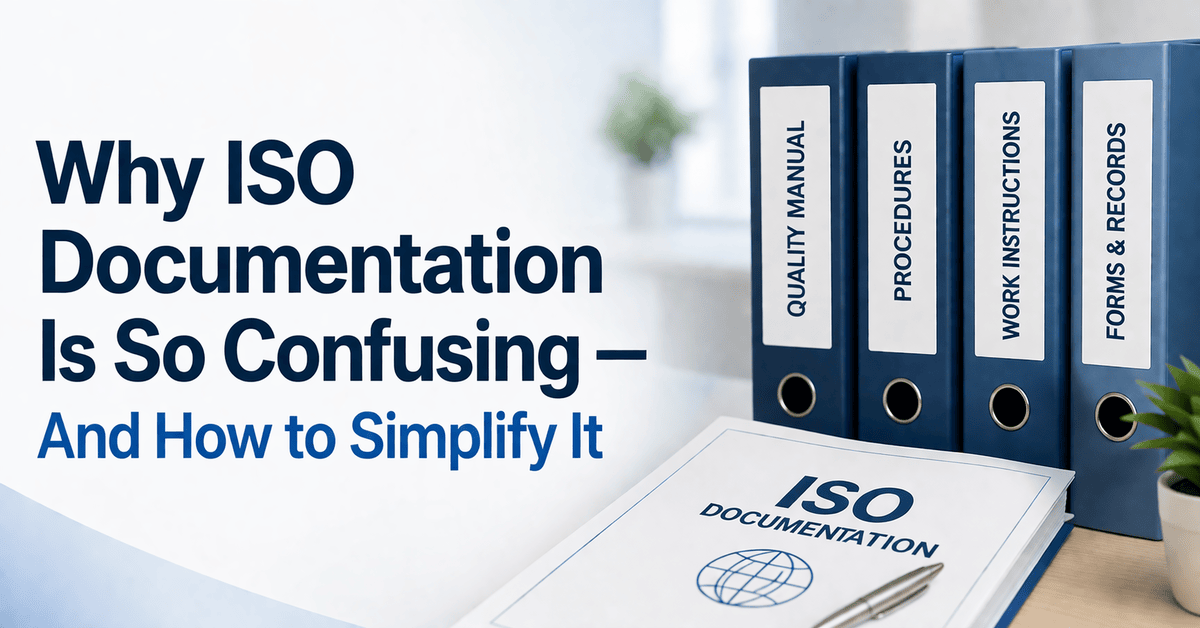
If you've ever sat down to begin ISO documentation and felt like you were staring at a wall of requirements written in a language you almost understand — you're in very good company. This post breaks down exactly why that confusion happens, and more importantly, what you can do about it.
Let's be honest about something. ISO certification is widely pursued, widely respected, and genuinely valuable for any business looking to compete at a serious level. And yet, the moment most teams sit down to begin the documentation process, something shifts. The enthusiasm dims a little. The standard — whichever one it happens to be — starts to feel less like a framework and more like a puzzle missing half its pieces.
This is not a reflection of your team's capability. It is a reflection of how ISO documentation is structured, and what it actually demands of the people responsible for producing it. Understanding that distinction is the first step toward making the process far less painful.
So why is ISO documentation genuinely difficult?There are several reasons, and they tend to compound on each other in frustrating ways. Let's walk through the most common ones.
1. The language of the standardISO standards are written in normative language — precise, clause-by-clause, with terms that carry specific definitions. Words like "shall," "should," and "may" are not interchangeable; each carries a different level of obligation. For someone encountering the standard for the first time, this language can feel deliberately opaque, even when it isn't meant to be.
2. No built-in starting pointThe standard tells you what your documentation must achieve. It does not tell you how to structure it, what order to write it in, or what a finished document actually looks like. You're handed a destination with no map to get there.
3. The volume of interconnected requirementsEach clause of the standard doesn't stand alone. Clause 8 references Clause 6. Clause 10 feeds back into Clause 4. Your procedures need to be consistent with your manual, and your records need to match your procedures. A single inconsistency anywhere in the chain becomes an audit finding.
4. The gap between operations and documentationMost teams understand their own operations quite well. The challenge is translating those operations into documentation that meets the standard's exact requirements — without over-documenting, under-documenting, or losing the practical reality of how the business actually runs.
"The standard tells you what the destination looks like. It doesn't give you directions. That's where most teams lose time — not because they lack knowledge of their own business, but because they're navigating without a map."
The parts that trip up even experienced teamsEven businesses that have been through certification before often find that revisiting or updating their documentation is harder than expected. Standards evolve — ISO 9001 moved from 2008 to 2015, ISO 27001 was updated in 2022 — and the structural shifts between versions are not always minor. Teams that documented well for one version sometimes find their documents partially obsolete under a new one.
Beyond version changes, there are a few specific areas that consistently create confusion regardless of experience level.
Context of the organization (Clause 4)This section requires businesses to identify internal and external factors that affect their management system — their interested parties, their scope, their processes. It sounds straightforward until you start writing it, at which point the question of "how much is enough?" becomes genuinely difficult to answer. Too brief and it won't satisfy an auditor. Too detailed and it becomes disconnected from the rest of the documentation.
Risk-based thinkingThe 2015 revision of ISO 9001 replaced the prescriptive preventive action requirement with a broader concept of risk-based thinking. For teams used to a defined preventive action procedure, this shift created uncertainty. Risk registers, risk assessments, and the documentation of risk management actions now need to flow naturally through the system — but what that looks like in practice isn't always clear from the standard alone.
Documented informationISO 9001:2015 and its contemporaries use the term "documented information" to cover what previous versions called both documents and records. The flexibility this creates is genuinely useful — you can structure your documentation in a way that suits your organization. But that same flexibility means there's no obvious template, and teams often end up either over-engineering their document control system or producing documentation that lacks the traceability auditors expect.
WORTH KNOWINGThe most common source of confusion in ISO documentation is not understanding the requirements poorly — it's not knowing which format, structure, and level of detail satisfies them. That's a structural problem, not a knowledge problem, and it has a structural solution.
How to actually simplify itThe good news — and it genuinely is good news — is that the confusion around ISO documentation is almost entirely a structural problem. That means it responds well to structural solutions. Here are the approaches that consistently make the biggest difference.
1. Start with the document hierarchy, not the clausesBefore writing a single word of content, map out the full set of documents you'll need: the quality manual (or equivalent), tier-two procedures, work instructions, forms, and audit checklists. Knowing where each document sits in the hierarchy — and how they reference each other — prevents the inconsistencies that create audit findings later.
2. Write for your auditor, not your internal audienceThe people reading your documentation during an audit are checking specific things: does this document satisfy Clause X, is it consistent with Document Y, does it demonstrate that the requirement is actually being met? Write with that reader in mind. Clear, unambiguous language that maps visibly to the standard's requirements will always serve you better than elaborate prose.
3. Use a pre-structured framework where availableOne of the most effective ways to eliminate structural confusion is to start from a documentation architecture that already satisfies the standard's requirements — rather than building that architecture from scratch. Editable documentation kits, built by experienced ISO consultants, provide exactly this: a complete, clause-aligned structure that your team populates with your organization's specific information.
4. Cross-reference as you writeEvery time a document references a clause, record it. Every time a procedure references a form, link them. Building this cross-reference index as you go makes your documentation set internally consistent and dramatically simplifies the audit preparation process.
5. Review for practical accuracy, not theoretical completenessA common mistake is writing documentation that perfectly describes how processes should work in theory, but doesn't reflect how they actually work in practice. Auditors will ask your staff to demonstrate compliance with documented procedures. If what's written doesn't match what's done, you'll have findings regardless of how well the document was written.
What this means for your organization right now If you're at the beginning of your ISO journey, the single most valuable thing you can do is invest in the right structure before writing a word of content. The confusion that most teams experience doesn't come from the standard being genuinely incomprehensible — it comes from approaching it without a map.
If you're mid-process and feeling like things are getting complicated, it's worth pausing to review your document hierarchy before pushing forward. Time spent correcting structural issues now is far less costly than correcting audit findings after the fact.
And if you're a business that has been through certification before and is now working through a renewal or an upgrade to a newer version of the standard — the same principles apply. A structured framework, applied consistently and updated accurately, is what keeps your documentation system functional across certification cycles.
ISO documentation doesn't have to be as confusing as it first appears. The complexity is real, but it's manageable — particularly when you approach it with the right framework, the right tools, and a clear understanding of what the standard is actually asking for.
At Global Manager Group, this is precisely what we've spent over two decades building: editable documentation kits for more than 50 ISO standards, designed and structured by experienced consultants who have guided organizations through live certification audits across more than 36 countries. The structure is already there. Your job is simply to bring your organization's knowledge to it.
At Global Manager Group, the approach is built around reducing that structural confusion rather than adding to it. Alongside editable ISO documentation kits that provide a complete, clause-aligned framework ready for immediate use, the company also offers practical consultancy support for organizations that prefer guided implementation. This combination allows businesses to choose the level of involvement that suits them — whether that means independently customizing a proven documentation system, or working with experienced consultants to navigate more complex requirements. In both cases, the objective remains the same: to replace uncertainty with clarity, and to make ISO implementation a structured, manageable process rather than an open-ended exercise.
Explore Global Manager Group's full range of editable ISO documentation kits — including ISO 9001, ISO 14001, ISO 27001, ISO 22000, and more — at globalmanagergroup.com. Demo downloads available before purchase.



Comment (0)